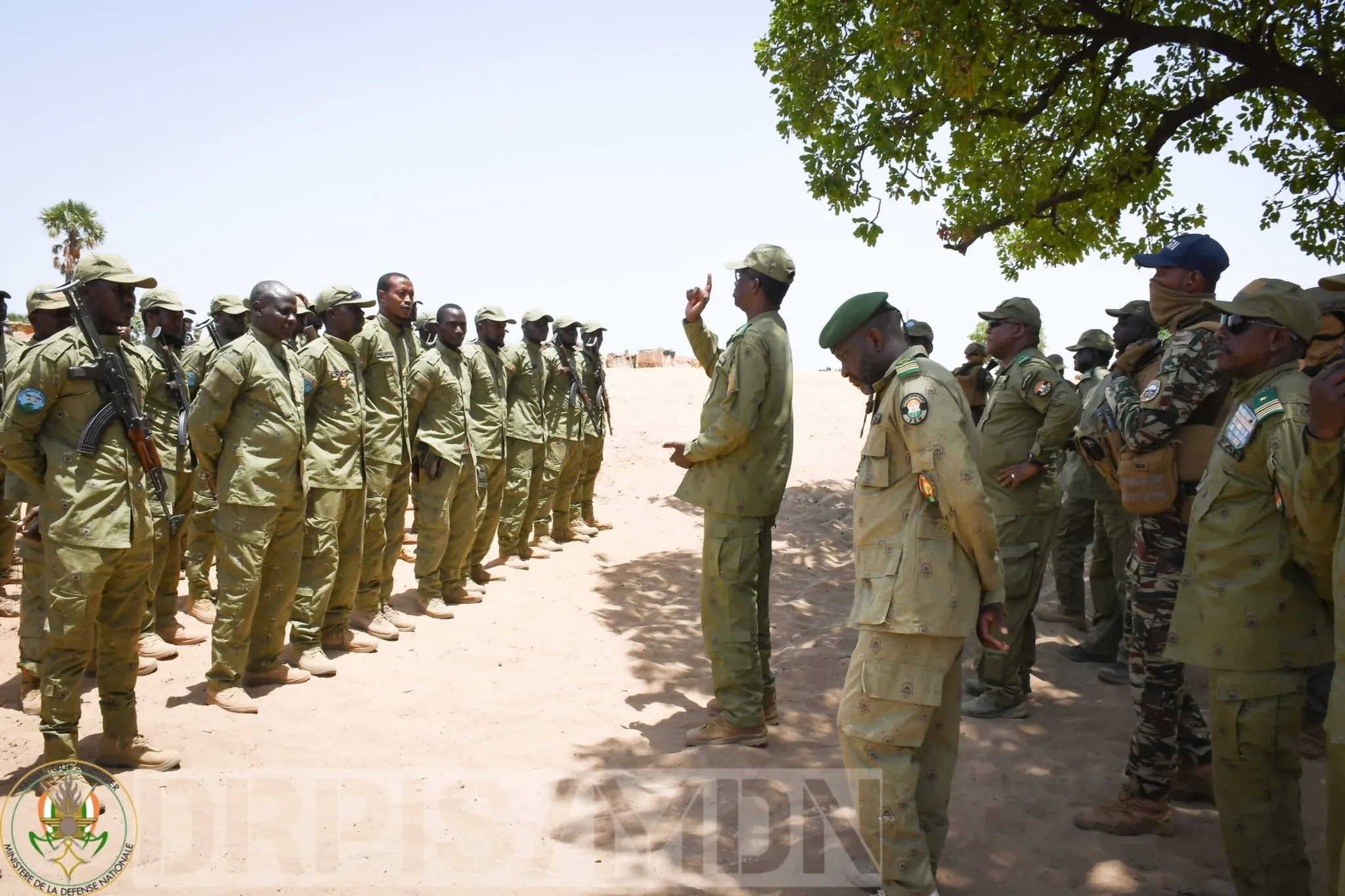
Defense Minister Salifou Mody conducted a full tour of military frontlines across various regions from May 10 to May 14, 2026, to assess security efforts and engage directly with the nation's defense and security forces. This critical five-day mission saw the Minister travel extensively, gathering key insights into the operational realities faced by troops. During his visit, Minister Mody held a general briefing with the FDS (Defense and Security Forces) at Camp AGALI in Dosso, emphasizing the strategic importance of this key military installation. The tour aimed to gather firsthand information on operational readiness, evaluate existing security protocols, and identify challenges faced by troops on the ground in diverse geographical and operational environments. The weather conditions during the visit were notably challenging, with temperatures reaching a high of 44° Celsius in some areas, showing the demanding conditions under which the FDS operate. Minister Mody's direct engagement with the FDS personnel, from command staff to frontline soldiers, showed the ongoing commitment to bolstering national security and ensuring the well-being and effectiveness of the forces. The Minister's presence served as a significant morale booster, demonstrating high-level governmental support for the men and women dedicated to national defense.
Extensive Regional Tour and Strategic Engagements
Defense Minister Salifou Mody's extensive tour included visits to multiple military and security installations across various regions, reflecting a broad assessment of the country's defense posture. The Minister's itinerary commenced with significant engagements in the Filingué region. There, he visited the 13th BIA (Bataillon d'Intervention et d'Assistance) in Filingué, where he reviewed the battalion's capabilities and discussed its operational challenges. Concurrently, the delegation also visited the National Gendarmerie Group located in the same city, assessing their role in maintaining law and order and contributing to national security. These visits allowed for a detailed examination of the coordination between different security branches.
Following these initial stops, the delegation proceeded to critical security points further afield. They made stops at the 1st GARSI-SAHEL (Groupement Anti-Terroriste et de Sécurisation des Sites Industriels), a specialized unit key for protecting vital national assets, and the National Guard detachment base in Sanam. These visits provided an opportunity to understand the specific security requirements of industrial sites and the readiness of the National Guard in these strategic locations. The Minister's interactions at these bases focused on operational effectiveness and the welfare of the personnel.
In Konni, the Minister visited the Bazaga Battalion, reviewing its operations, personnel readiness, and logistical support. This engagement allowed for a direct assessment of a key infantry unit's capabilities. Continuing the tour, the delegation proceeded to Soukoukoutane, a strategically important area, where Minister Mody visited a Gendarmerie Nationale position. This visit provided insights into the gendarmerie's role in rural security and border control. Further engagements included a visit to a FAN (Forces Armées Nigériennes) detachment in Karakara and a mixed detachment operating in Kizamou, noting the diverse operational environments and the adaptability of the national forces. These stops were key for understanding the deployment and effectiveness of various units in different operational contexts.
In Gaya, the mission visited the command post of the 73rd Interarms Battalion, where discussions centered on integrated defense strategies and inter-service cooperation. The extensive regional tour also included stops at critical infrastructure, with the mission making visits to pipeline security posts PS 5 and PS 6. These visits were part of the broader effort to assess security measures protecting vital economic installations and to ensure the continuous flow of essential resources. The inspection of these posts allowed the Minister to directly observe the security protocols in place and to engage with the personnel responsible for safeguarding these national assets. Each stop provided valuable context and direct observation of the forces' operational capabilities and needs.
Security Briefings and Councils for Coordinated Action
Defense Minister Salifou Mody's tour was punctuated by high-level security briefings and council meetings designed to foster coordinated action and strategic planning. In Tahoua, Minister Mody presided over the Regional Security Council (CRS), a key forum for addressing regional security challenges. During this key meeting, six essential points were discussed in depth, forming the core of the region's security strategy. These points encompassed a thorough review of the general security situation in the region, emphasizing the need for heightened vigilance across all sectors. Discussions also focused on promoting solidarity between various security forces, ensuring smooth cooperation and mutual support in operations. Key agenda items included General Mobilization, aimed at optimizing resource allocation and personnel deployment, and the implementation of the 'Domol Leydi' concept, which seeks to integrate traditional and modern security approaches. A significant portion of the deliberations was dedicated to fostering collaboration with civilians to enhance intelligence gathering and community-based security efforts, recognizing the indispensable role of the populace in national defense.
The Minister continued his engagements by presiding over a Regional Security Council meeting in Dosso, further extending the reach of these critical discussions. This meeting in Dosso mirrored the full approach taken in Tahoua, addressing the specific security dynamics of the region. In addition to the CRS, Minister Mody also led a separate meeting of cadres in Dosso, addressing key personnel on security matters and operational strategies. This dedicated session allowed for focused discussions with senior officers and administrative leaders, ensuring that strategic directives were clearly communicated and understood. These meetings served as platforms for in-depth discussions on regional challenges, coordinated responses, and the continuous adaptation of security strategies to evolving threats. The interactive nature of these sessions facilitated direct feedback from local commanders and officials, enriching the overall strategic planning process.
During his tour, Minister Mody extended his heartfelt congratulations to the personnel of the Force de Protection et de Développement. He specifically acknowledged their exemplary work in securing vital economic installations, noting the indispensable importance of their role in national stability and development. The Minister's recognition showed the government's profound appreciation for their persistent efforts in safeguarding critical infrastructure, which forms the backbone of the nation's economy. This commendation served to boost morale and reinforce the strategic value of their contributions to national prosperity and security.
Strategic Infrastructure Development and Diplomatic Outreach
Minister of State for National Defense, General Salifou Mody, undertook a full visit to FDS (Forces de Défense et de Sécurité) positions across the regions of Tillabéri, Dosso, and Tahoua, demonstrating the breadth of his strategic oversight. In Tahoua, a key regional hub, Minister Mody conducted a general briefing with FDS personnel stationed at the 42nd BIA, a critical unit in the region's defense architecture. This briefing provided an opportunity for direct communication and strategic guidance to the troops. General Salifou Mody's delegation was notably distinguished, including General Salaou Barmou, who serves as the esteemed Chief of Staff of the Armies, alongside other senior military officials. The presence of such high-ranking military leadership showed the gravity and strategic importance of the tour. In Tahoua, the Minister further solidified his understanding of regional defense capabilities by visiting the 401 Air Force base and the 4th Gendarmerie Legion, assessing their operational capabilities and readiness to respond to various security challenges.
A significant highlight of the tour was the delegation's visit to the construction site of the National Training Center of Garadoua, located in Keita. This stop noted the government's forward-looking focus on military development and the enhancement of infrastructure key for the future training and preparedness of the armed forces. The inspection of this facility showed the long-term investment in human capital and modern military capabilities. The development of such a center is vital for ensuring that the FDS receive advanced training, keeping pace with evolving security threats and technological advancements.
Throughout the extensive tour, the delegation paid courtesy visits to customary chiefs at all stages of their journey. These interactions were not merely ceremonial; they showed diplomatic efforts and community engagement as an integral part of the broader security initiatives. Engaging with traditional leaders allowed the Minister to foster goodwill, build trust between the military and local populations, and gather valuable insights into local dynamics and security concerns. These visits reinforced the government's commitment to a holistic security approach that integrates both military operations and civilian cooperation, recognizing that effective national security is built on strong community relationships and mutual understanding. The Minister's engagement with these local leaders demonstrated a full strategy that extends beyond military installations to embrace the social fabric of the nation.
