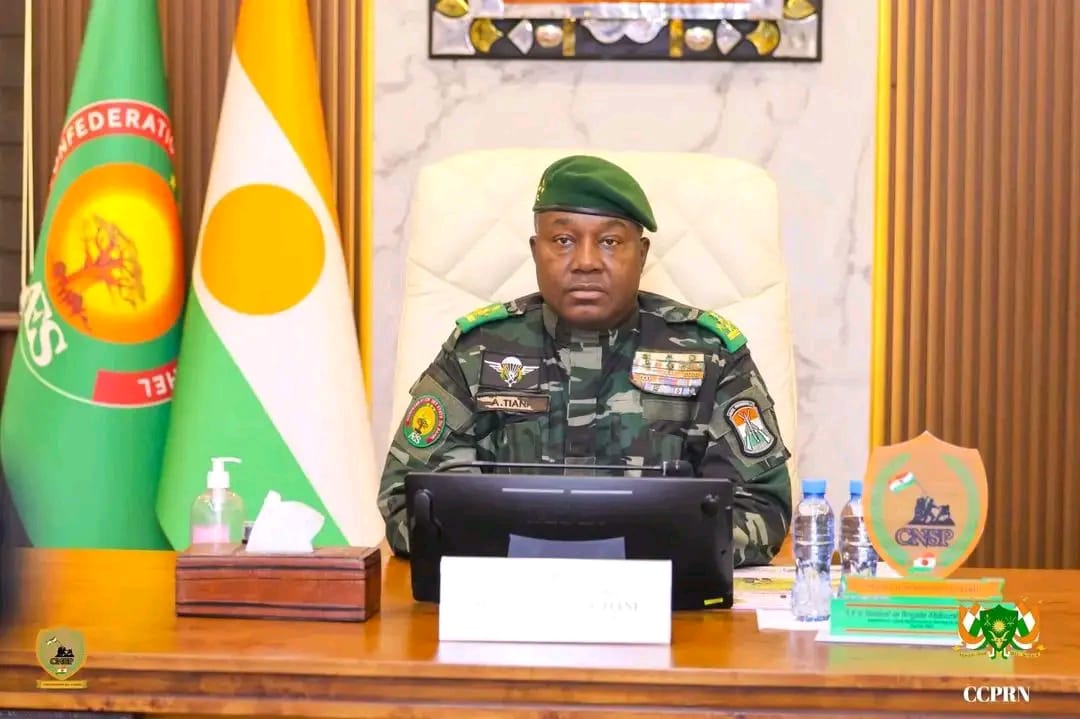
President Abdourahamane Tiani of Niger signed a decree on Monday, June 8, 2026, ordering the suppression of several government services. The directive targets entities attached to or under the supervision of the Presidency of the Republic, the Prime Minister's Office, and the General Secretariat of the Government. Among the dissolved bodies are the Centre National d’Etudes Stratégiques et de Sécurité (CNESS) and the Fonds d’Investissement pour la Sécurité Alimentaire et Nutritionnelle (FISAN).
The decree also dismantles the Agence de Modernisation des Villes du Niger (AMV-Niger), the Haute Autorité du Waqf, and the Inspection Générale de la Gouvernance Administrative (IGGA). Additionally, the Haut-Commissariat à la Modernisation de l’Etat (HCME), the Autorité de Régulation du Secteur de l’Eau (ARSeau), and the Autorité de Régulation du Secteur des Transports (ARST) are affected. The Haute Autorité de Protection des Données à Caractère Personnel (HAPDP) is likewise suppressed under the new order.
Reassignment of Government Functions
The decree signed by President Abdourahamane Tiani includes specific provisions for the reassignment of responsibilities from the dissolved government services. The missions previously carried out by the Centre National d’Etudes Stratégiques et de Sécurité (CNESS) are now transferred to the Ministry of National Defense. This move consolidates strategic and security analysis functions under the defense portfolio.
The responsibilities of the Fonds d’Investissement pour la Sécurité Alimentaire et Nutritionnelle (FISAN) have been transferred to the Ministry of Agriculture and Livestock. This aims to integrate food security and nutritional investment initiatives directly within the agricultural sector's purview. The Haute Autorité du Waqf's missions are now assigned to the Ministry of Economy and Finance. This shift brings the management and oversight of waqf assets under the central financial authority of the government.
Several other key entities have had their functions reassigned to a single ministry. The missions of the Inspection Générale de la Gouvernance Administrative (IGGA), the Haut-Commissariat à la Modernisation de l’Etat (HCME), the Autorité de Régulation du Secteur de l’Eau (ARSeau), the Autorité de Régulation du Secteur des Transports (ARST), and the Haute Autorité de Protection des Données à Caractère Personnel (HAPDP) are all transferred to the Ministry of Interior, Public Security, and Territorial Administration. This broad reassignment places a wide range of regulatory, oversight, and modernization functions under the interior ministry's jurisdiction, covering aspects from administrative governance and state modernization to the regulation of water, transport, and personal data protection.
Context of Administrative Reforms
The dissolution of these government services and the reassignment of their functions reflect a broader initiative within Niger's administration to streamline governance structures. President Abdourahamane Tiani's decree centralizes various responsibilities under key ministries, aiming to consolidate oversight and improve administrative efficiency. The transfer of strategic and security analysis from the Centre National d’Etudes Stratégiques et de Sécurité (CNESS) to the Ministry of National Defense, for instance, integrates national security planning directly within the defense apparatus.
Similarly, placing food security and nutritional investments, previously managed by the Fonds d’Investissement pour la Sécurité Alimentaire et Nutritionnelle (FISAN), under the Ministry of Agriculture and Livestock is intended to create a more cohesive approach to agricultural policy and its impact on the populace. The move to assign the Haute Autorité du Waqf's missions to the Ministry of Economy and Finance suggests an effort to bring financial management of waqf assets into the central economic framework. The Ministry of Interior, Public Security, and Territorial Administration has taken on a significant range of new duties, encompassing administrative governance, state modernization, and regulatory functions for water, transport, and personal data protection, indicating a considerable expansion of its mandate.
Potential Implications and Analysis
The restructuring outlined in President Abdourahamane Tiani's decree suggests a move towards greater centralization of governmental authority within Niger. Consolidating diverse functions under a smaller number of key ministries could streamline decision-making processes and potentially enhance oversight. The shift of regulatory bodies and administrative governance functions to the Ministry of Interior, Public Security, and Territorial Administration, for example, expands its remit significantly across various sectors. This administrative overhaul may aim to improve efficiency and resource allocation by reducing bureaucratic layers and ensuring closer alignment of policy implementation with ministerial objectives. The changes could also reflect an effort to assert stronger state control over strategic sectors and public services.