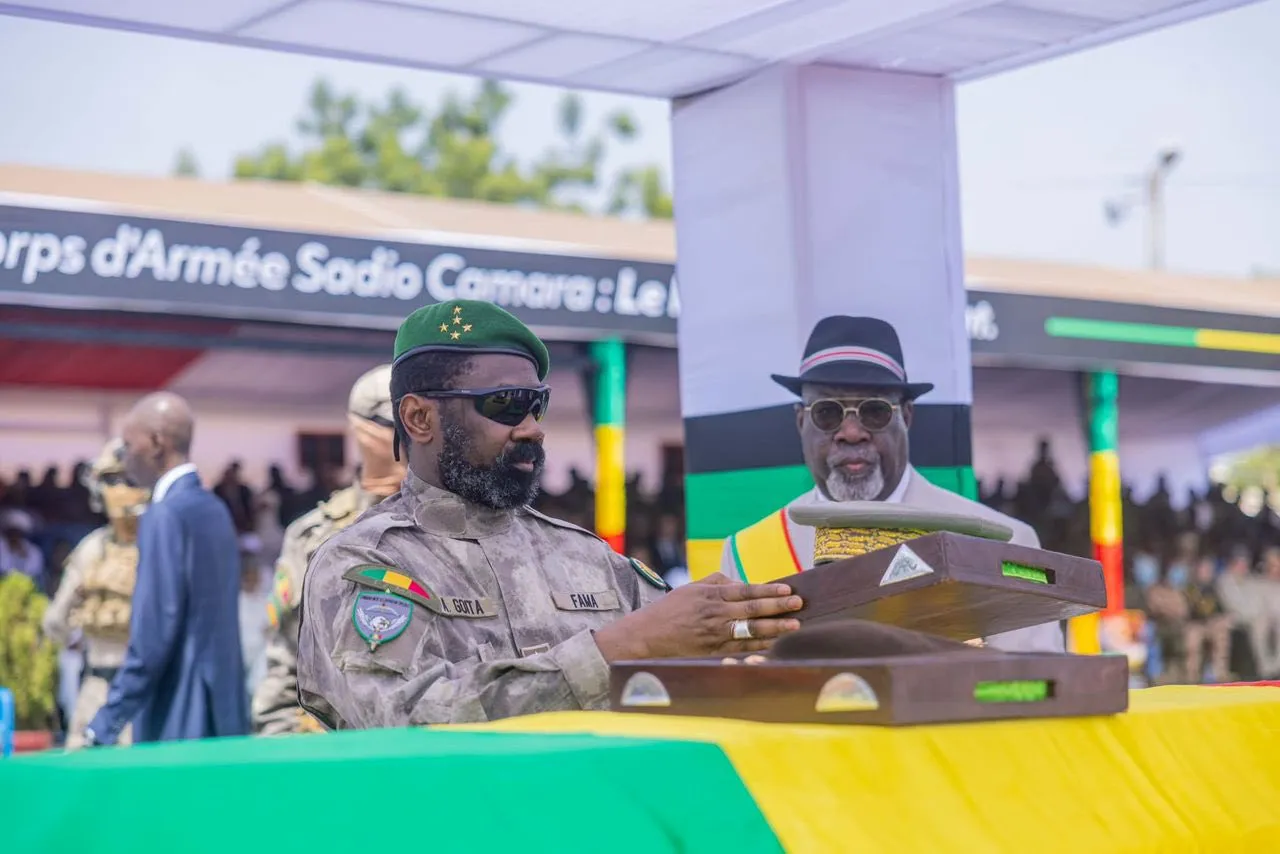
An official national funeral for General Sadio Camara, Mali's former Minister of State, Minister of Defense and Veterans Affairs, took place on Thursday, April 30, in Bamako. The solemn ceremony honored the life and service of a prominent figure in Mali's recent history. General Camara died on April 25, 2026, during a coordinated militant attack, attributed to armed terrorist groups, which involved a car bomb explosion outside his home on Saturday. This attack, a stark reminder of the persistent security challenges facing the nation, prompted an immediate outpouring of condolences from regional allies. An important delegation from Niger, composed of members of the CNSP and the government, attended the funeral to express solidarity and compassion to the Malian authorities, noting the deepening ties within the Alliance of Sahel States.
The Nigerien delegation was led by Army General Salifou Mody, Minister of State and Minister of National Defense, a key figure in Niger's current leadership. He was accompanied by H.E. Mr. Bakary Yaou Sangaré, Minister of Foreign Affairs, Cooperation and Nigeriens Abroad, demonstrating the diplomatic weight of the visit. Also present were Dr. Soumana Boubacar, Minister Director of the President's Cabinet and Government Spokesperson, ensuring official communication channels were represented. Further reinforcing the delegation's significance were Colonel-Major Abdoul Kadri Amadou Daouda, Minister of Urban Planning and Housing, and Brigadier General Ibro Amadou Bacharou, Chief of Staff of the President of the Republic, accompanied by several other high-ranking officials from various sectors of the Nigerien government and military.
In a further display of regional unity, a joint delegation from Niger and Burkina Faso also participated in the funeral proceedings. This combined representation was led by Burkinabe Minister of Defense General Célestin Simporé, showing the collective commitment of the allied nations. The joint delegation carried a message of condolences from the highest Nigerien and Burkinabe authorities to the Malian people, emphasizing the shared grief and mutual support among the member states of the Alliance of Sahel States. President Assimi Goïta of Mali expressed his deep gratitude to his Nigerien and Burkinabe counterparts for this gesture of solidarity, according to reports from official channels, acknowledging the vital importance of such regional backing during challenging times.
Sahel Alliance Shows Unity
The Nigerien delegation's participation in the funeral reflected the dynamic of solidarity, fraternity, and reinforced cooperation among the member states of the Alliance of Sahel States (AES). This active engagement in a moment of national mourning signifies a practical demonstration of the principles upon which the AES was founded. The delegation paid tribute to the memory of General Sadio Camara, acknowledging his commitment and sacrifice for the defense of Mali's sovereignty and territorial integrity, as well as the broader Sahelian space. His contributions were recognized as integral to the ongoing efforts to stabilize the region and combat the widespread threat of terrorism.
During the event, Brigadier General Célestin Compaoré reaffirmed the determination of AES countries to continue the fight against terrorism with greater vigor. His statement showed the collective resolve of the alliance to confront shared security threats effectively. The presence of high-level officials from both Niger and Burkina Faso alongside Malian authorities showed a unified stance among the allied nations following the general's death. This collective expression of condolence and resolve noted the strengthening ties within the AES as they confront shared security challenges in the region, including cross-border militant activities and the need for coordinated security responses. The alliance aims to foster a unified front against destabilizing forces, ensuring mutual support and shared strategies in the face of ongoing threats. This coordinated approach is seen as key for the long-term stability and security of the Sahel.
General Camara's Legacy
General Sadio Camara, born in 1979 in Kati, a garrison town near the Malian capital Bamako, became widely known to Malians in August 2020. This was the moment he appeared on national television alongside other officers who had orchestrated the overthrow of President Ibrahim Boubacar Keita. The coup marked a significant turning point in Malian politics, ushering in a period of military-led governance. Camara subsequently served as defense minister in both of Mali’s successive military governments following the coup, playing a central role in shaping the nation's security policies during a turbulent era. His tenure saw a reorientation of Mali's defense partnerships and a renewed focus on internal security challenges.
The officers involved in the 2020 coup had accused then-President Keita of being unduly influenced by France and of failing to adequately address the escalating militant attacks plaguing the country. These accusations resonated with a segment of the Malian population frustrated by the persistent insecurity and perceived foreign interference. The coup leaders articulated a vision for a more sovereign and secure Mali, which General Camara was instrumental in attempting to implement. His career trajectory, from a military officer to a key political figure, reflected the tumultuous political landscape of Mali in recent years. His commitment to national defense was a consistent theme throughout his public life, culminating in his tragic death while still actively engaged in the nation's security efforts.
Shifting Security Landscape
General Sadio Camara was a key architect of the military government’s security partnership with Russia, a strategic pivot that redefined Mali's international alliances. Following the 2020 coup, the new Malian junta turned to Russia as its primary security partner, leading to the expulsion of French troops and United Nations peacekeepers from the country. This shift marked a significant departure from Mali's traditional security alignments and was championed by figures like General Camara, who sought new approaches to counter the entrenched militant threats. The militant attack that resulted in General Camara's death marked the largest such incident in over a decade, showing the severity of the threat despite the new security arrangements. The scale of the attack noted the persistent and evolving nature of the conflict with armed terrorist groups.
Amidst these security shifts and the ongoing fight against militant groups, the recently established Africa Corps, a Russian military unit, announced that its fighters had withdrawn from Kidal. This withdrawal occurred two days after separatists stated they had captured the key northern city of Kidal, a strategically important location in Mali's vast northern regions. The Africa Corps is estimated to have approximately 2,000 troops deployed in Mali, playing a significant role in the country's security operations alongside Malian forces. This Russian military unit reports directly to the defense ministry in Moscow, indicating a direct line of command and strategic oversight from the Russian capital regarding its operations in Mali. The situation in Kidal, combined with the withdrawal of the Africa Corps, reflects the complex and multi-faceted security challenges that continue to confront Mali and its regional allies. The ongoing struggle against both separatist movements and armed terrorist groups continues to demand significant attention and resources from the Malian government and its partners within the Alliance of Sahel States.