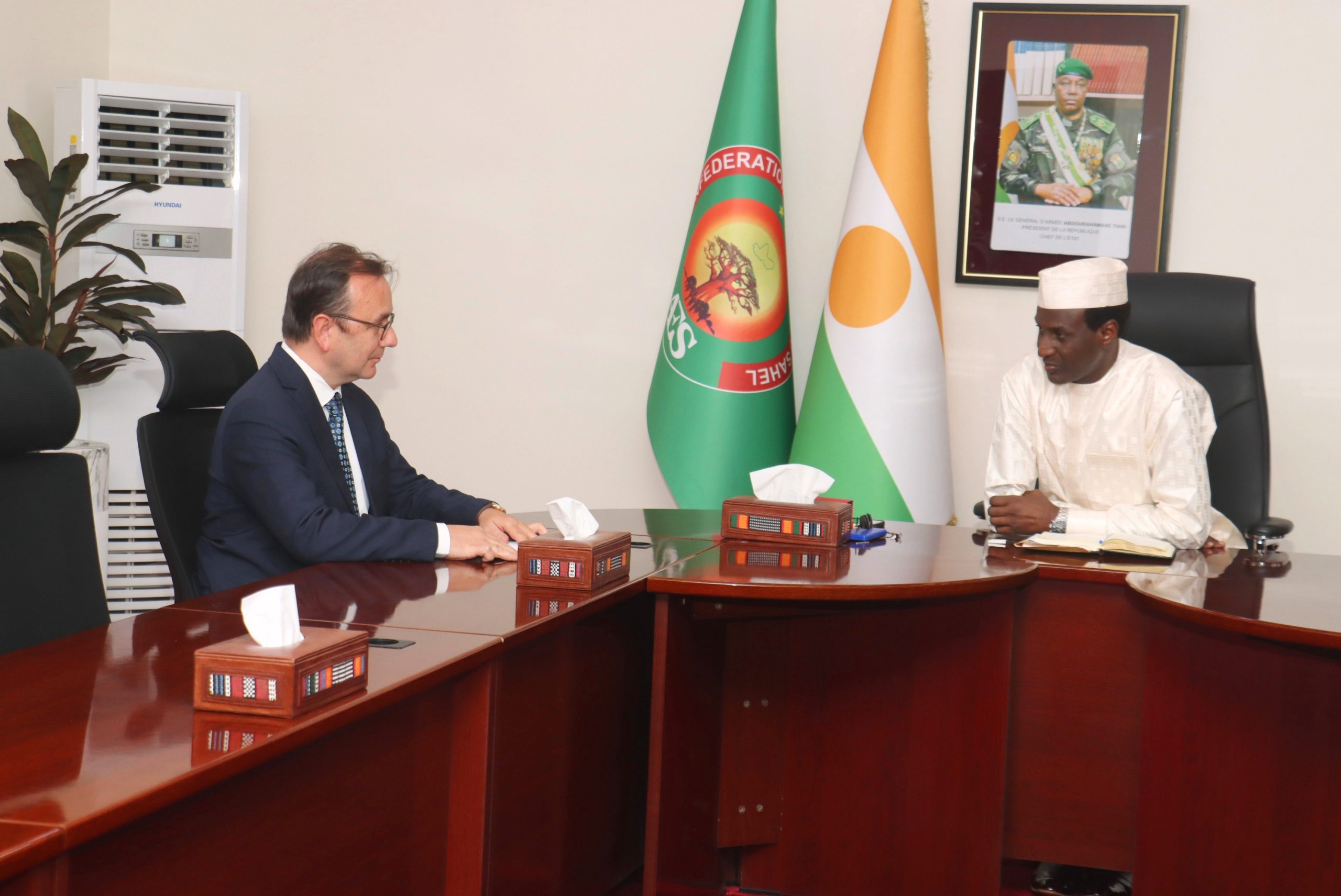
Niger Prime Minister Ali Mahaman Lamine Zeine met with the UK Special Envoy for the Sahel, Stephen Hickey, in Niamey on Tuesday. The two officials held exchanges regarding the ongoing instability in the Sahel region, a topic of significant international concern given its broad implications for regional and global security. Their discussions focused on collaborative efforts and strategies to address the complex challenges faced by countries in the Sahel, including widespread security issues, humanitarian crises, and the imperative for sustainable regional development. This high-level meeting shows continued diplomatic engagement between Niger and the United Kingdom amidst the volatile security landscape that characterizes much of the Sahel, noting a shared commitment to fostering stability and resilience in the area. The dialogue aimed to reinforce existing partnerships and explore new avenues for cooperation in a region grappling with multifaceted crises.
Key Discussions Held
The meeting between Niger Prime Minister Ali Mahaman Lamine Zeine and UK Special Envoy for the Sahel Stephen Hickey in Niamey on Tuesday covered a range of critical issues impacting the Sahel region, reflecting the urgency and complexity of the situation. Discussions centered on the multifaceted challenges contributing to regional instability, with both parties exploring potential avenues for cooperation that could lead to tangible improvements. The talks noted the shared concern over the escalating security situation across the Sahel, emphasizing the urgent need for coordinated international responses to address the root causes and consequences of this instability. The full agenda demonstrated a commitment to understanding the intricate dynamics at play and formulating effective, collaborative solutions.
Prime Minister Zeine and Special Envoy Hickey engaged in detailed exchanges concerning the ongoing security threats that plague the region, including the widespread activities of various armed groups and the broader implications these groups have for civilian populations. The dialogue also touched upon the severe humanitarian consequences of the instability, emphasizing the critical necessity of addressing the widespread displacement of populations and the chronic food insecurity within the affected areas. Both officials reportedly showed the profound importance of regional stability not only for the immediate well-being of Sahelian populations but also for wider international security, recognizing the interconnectedness of global challenges. The discussions delved into the specifics of how security operations could be better supported while simultaneously ensuring the protection of civilians and adherence to humanitarian principles.
The agenda included extensive considerations for long-term development strategies aimed at fostering resilience and promoting sustainable economic growth in the Sahel. The officials discussed potential partnerships in key areas such as education, which is vital for long-term human development; infrastructure, necessary for economic connectivity and service delivery; and climate adaptation, which is increasingly critical in a region severely impacted by environmental degradation. These areas were recognized as integral components of a full approach to achieving lasting stability and prosperity. The United Kingdom's commitment to supporting regional initiatives was a key theme throughout the discussions, with Special Envoy Hickey outlining potential areas where UK expertise, financial resources, and diplomatic influence could contribute significantly to ongoing efforts. This included exploring mechanisms for capacity building within local institutions and supporting community-led development projects.
The meeting also served as a key opportunity for Prime Minister Zeine to articulate Niger's perspective on the regional crisis and to clearly outline its priorities for international engagement. This direct exchange aimed to establish a clearer understanding of the challenges from the ground, ensuring that diplomatic efforts are well-aligned with the immediate and long-term needs of the Sahelian countries. Both sides acknowledged the inherent complexity of the situation, recognizing that it requires sustained dialogue, flexible strategies, and adaptive approaches to achieve lasting peace and meaningful development outcomes. The diplomatic exchange signals continued and strong engagement between Niger and the United Kingdom on these pressing regional matters, showing a mutual recognition that collaborative action is indispensable for navigating the current challenges. The depth of the discussions reflected a shared understanding that a holistic approach, integrating security, humanitarian, and development aspects, is critical.
Sahel Region Context
The Sahel region, a vast semi-arid belt stretching across Africa, faces persistent and complex challenges that contribute significantly to its ongoing instability. This expansive area, which includes countries like Niger, has become a focal point for international concern due to a convergence of severe security, humanitarian, and environmental crises. Political instability, frequently marked by coups d'état and widespread governance issues in several nations, has exacerbated an already fragile situation. These internal political upheavals often disrupt efforts towards long-term stability and sustainable development, creating dangerous power vacuums that can be exploited by various state and non-state actors, further entrenching cycles of violence and insecurity. The frequent changes in leadership and policy hinder consistent progress and erode public trust in state institutions.
Security in the Sahel remains a primary concern, with numerous armed groups operating across porous borders, making regional cooperation on counter-terrorism and border control critically important. These groups, some of which have established links to international extremist organizations, conduct frequent attacks on civilians and security forces, leading to widespread displacement and severe humanitarian emergencies. The persistent presence and aggressive activities of these non-state armed groups contribute significantly to the chronic insecurity, undermining state authority, disrupting essential public services, and eroding the rule of law in many areas. Efforts to counter these threats have involved both national armies and international partners, but the vastness of the territory, coupled with the adaptability and decentralized nature of these groups, presents considerable obstacles to achieving lasting peace and security. The complex interplay of local grievances, ethnic tensions, and external influences further complicates security interventions.
Humanitarian conditions in the Sahel have deteriorated alarmingly, driven by the triple threat of conflict, climate change, and entrenched poverty. Millions of people are internally displaced within their own countries or have become refugees in neighboring nations, relying heavily on humanitarian assistance for basic survival. Food insecurity is a recurring and devastating problem, with successive droughts and unpredictable floods severely impacting agricultural production and livestock, which represent the primary livelihoods for a large portion of the population. Access to basic services such as healthcare and education is also severely limited or completely absent in many conflict-affected zones, further compounding the vulnerability of communities and hindering prospects for future development. The humanitarian response is often challenged by access restrictions and funding gaps, making it difficult to reach all those in need.
Climate change disproportionately affects the Sahel, leading to accelerated desertification, acute water scarcity, and more frequent and intense extreme weather events. These environmental pressures intensify competition over dwindling natural resources, particularly between traditional pastoralist and farming communities, often escalating into inter-communal violence. The degradation of natural resources undermines traditional livelihoods, forces populations to migrate in search of viable land and water, and creates additional strain on urban centers and host communities. Addressing these profound environmental factors is considered key for building long-term resilience and achieving sustainable stability in the region, requiring significant investment in climate adaptation and mitigation strategies. The loss of biodiversity and ecosystem services further exacerbates the challenges faced by local populations.
International engagement in the Sahel has involved a wide range of diplomatic, security, and development initiatives, reflecting the global recognition of the region's strategic importance. Various countries and multilateral organizations have committed substantial resources to support counter-terrorism efforts, provide humanitarian aid, and implement development projects aimed at fostering economic growth and improving governance. However, the sheer scale and interconnectedness of the challenges require sustained and highly coordinated international attention, as the instability in the Sahel has broader implications for regional and global security, including potential ripple effects on migration and extremism. The ongoing diplomatic exchanges, such as the recent meeting in Niamey, reflect the continued recognition of the urgent need for collaborative solutions to address these multifaceted and evolving crises. The international community acknowledges that a failure to address the Sahel's challenges could have broad consequences beyond its borders.
UK's Regional Engagement
The United Kingdom maintains an active diplomatic presence and sustained engagement within the Sahel region, reflecting its steadfast commitment to addressing the complex security and development challenges facing countries such as Niger. This involvement is often characterized by high-level diplomatic exchanges, such as the recent meeting between Prime Minister Zeine and Special Envoy Hickey, and strong support for regional initiatives aimed at fostering stability, resilience, and good governance. The UK's full approach typically encompasses security cooperation, providing critical assistance for counter-terrorism efforts and capacity building for local security forces; humanitarian assistance, delivering aid to populations affected by conflict and climate shocks; and targeted development programming, recognizing the interconnected nature of these issues in the Sahel. This multi-faceted strategy aims to tackle both immediate crises and underlying vulnerabilities.
Through its Special Envoy for the Sahel, the UK engages directly and regularly with governments and regional organizations to discuss strategies for countering armed groups, improving governance structures, and promoting sustainable development pathways. These discussions frequently highlight the critical importance of international collaboration in tackling cross-border threats, which cannot be addressed by any single nation alone, and building the capacity of local institutions to respond effectively to the needs of their populations. The UK has consistently voiced its deep concern over the escalating instability in the region, emphasizing the urgent need for full solutions that address both immediate security needs and the underlying socio-economic vulnerabilities that often fuel conflict and extremism. This includes advocating for political solutions and inclusive governance.
UK foreign policy in the Sahel often aligns closely with broader international efforts to stabilize the region, working alongside key partners such as the European Union, the United States, and the United Nations to provide essential humanitarian aid to populations severely affected by conflict and climate change. Development initiatives supported by the UK typically focus on key areas such as education, enhancing access and quality for future generations; healthcare, strengthening public health systems; and economic diversification, creating new opportunities beyond traditional sectors to build long-term resilience and reduce the drivers of instability. The UK's engagement shows a strategic interest in regional security, acknowledging the broader implications of Sahelian instability for international peace and security, including the potential for increased irregular migration and the spread of extremist ideologies. Diplomatic efforts are sustained through various channels, including bilateral meetings, participation in multilateral forums dedicated to the Sahel, and engagement with regional bodies like the G5 Sahel.
Looking Ahead
Looking ahead, continued diplomatic engagements between Niger and international partners, such as the United Kingdom, are expected to remain key for effectively addressing the multifaceted challenges confronting the Sahel region. These discussions aim to build upon existing dialogues, translating shared concerns into tangible strategies for enhanced security cooperation, efficient humanitarian aid delivery, and strong long-term development initiatives. The ongoing instability within the Sahel necessitates sustained international attention and collaborative efforts to foster resilience, rebuild communities, and promote regional stability. Future meetings will likely focus on implementing agreed-upon initiatives, monitoring their effectiveness, and adapting approaches to the evolving political, security, and humanitarian situation in the region, including the complex dynamics impacting countries like Niger. The commitment to regular dialogue shows the recognition that only through collective action can the Sahel overcome its profound challenges and move towards a more secure and prosperous future.