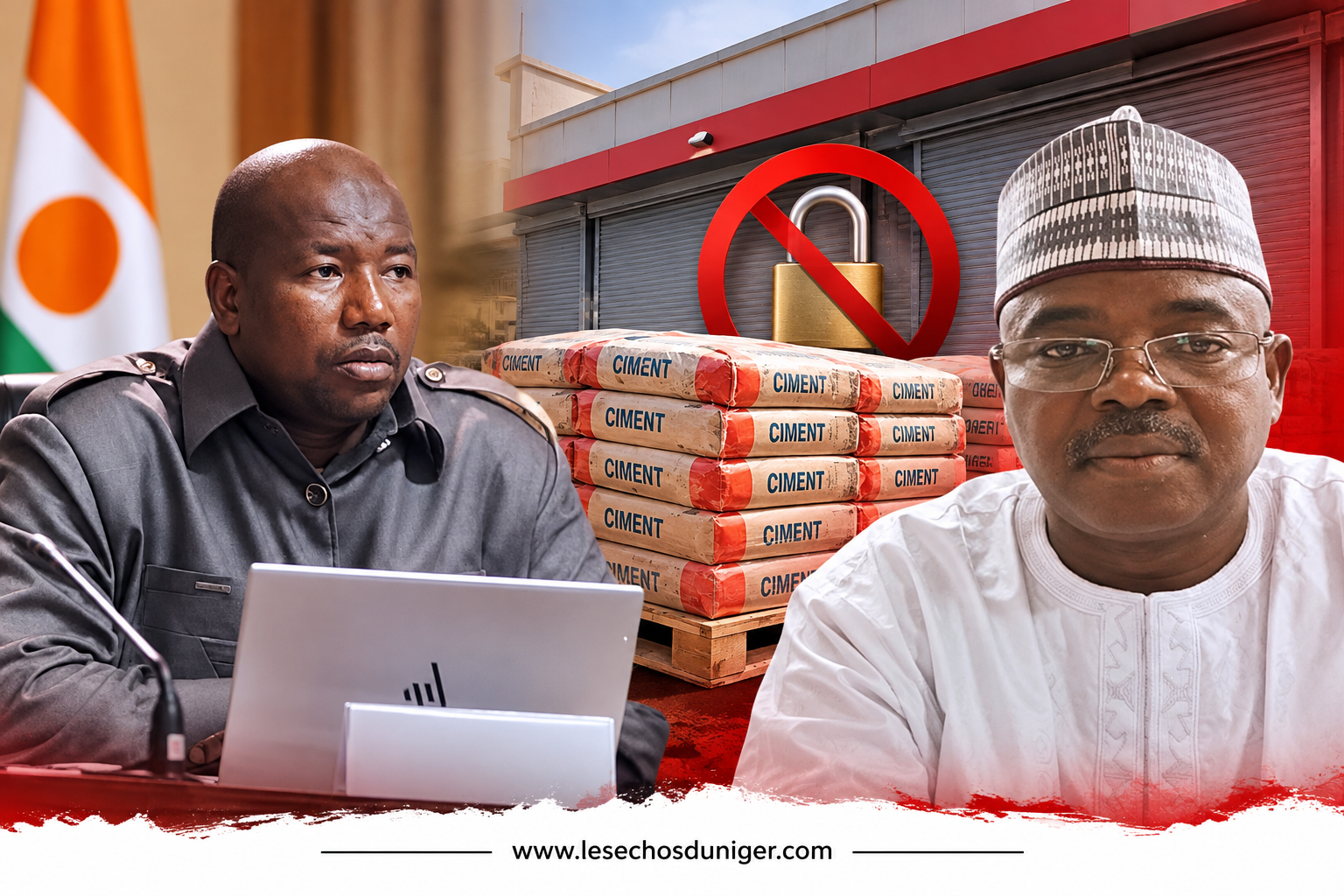
Niger's Minister of Commerce and Industry, Abdoulaye Seydou, has ordered the suspension of Établissements Aboubacar Charfo for a period of three months, effectively prohibiting the company from engaging in all commercial activity. This significant measure, targeting a major cement distributor, was enacted through a ministerial order dated September 3rd. The order was subsequently made public on Saturday, September 5th, 2026, signaling the government's firm resolve in its broader efforts to regulate the market and ensure fair commercial practices. The suspension specifically prohibits Établissements Aboubacar Charfo from conducting any form of commercial activity for the duration of these three months.
Minister Seydou had previously issued explicit warnings regarding practices deemed to disrupt the cement distribution system. He had stated unequivocally that such actions would be sanctioned rigorously, showing the government's commitment to upholding market integrity and preventing speculative behavior. The decisive action taken against Établissements Aboubacar Charfo directly reflects this commitment to enforcing regulatory compliance within the commercial sector, particularly concerning essential commodities like cement. The move illustrates the official stance that market disruptions will not be tolerated and will be met with stringent penalties.
Ministerial Tour and Alleged Recidivism Under Scrutiny
The events leading to the suspension began on September 3rd, the same day the ministerial order was dated. On this day, Niger's Minister of Commerce and Industry, Abdoulaye Seydou, personally conducted an extensive tour of seven cement sales sites located across Niamey, the capital city. During this inspection, a critical observation was made: two of the visited sites, both explicitly identified as belonging to Établissements Aboubacar Charfo, were found to be non-operational. These specific sites were located at prominent areas within the city, namely Stade Général-Seyni-Kountché and Quartier Sonni. The finding of non-operational sites during a ministerial inspection of cement distributors raised immediate concerns regarding supply and market conduct.
The official justification provided for the three-month suspension of Établissements Aboubacar Charfo cites Article 42, paragraph 3, of Law n°2019-56 of November 22, 2019. This particular law is central to competition regulations within Niger. The legal provision outlined in this article specifically permits the temporary closure of an entity and the prohibition of its commercial activity, particularly in cases involving recidivism. Recidivism, in this context, implies a repeat offense or a pattern of non-compliance. However, a notable aspect of the ministerial order itself is that it does not explicitly specify the exact facts or any prior infraction that would definitively characterize the alleged recidivism on the part of Établissements Aboubacar Charfo. This omission leaves some details regarding the specific grounds for the recidivism claim open to interpretation, despite the legal framework being cited.
Market Intervention and Pricing Controls Implemented
In a parallel and concerted effort to stabilize the market and alleviate potential shortages, the Ministry of Commerce and Industry announced a significant intervention. Over 20,000 tons of cement are scheduled for release onto the Niamey market within a concentrated period, specifically between September 3rd and September 9th. This substantial injection of supply is intended to directly address prevailing supply concerns and to effectively regulate pricing within the capital, countering any artificial scarcity or price inflation. The Ministry's proactive measure aims to ensure that consumers have access to this vital construction material at fair and controlled prices.
To further ensure transparency and affordability, the Ministry of Commerce and Industry announced specific, regulated pricing for these upcoming cement releases. Consumers can expect 32.5 grade cement to be sold at a fixed price of 60,000 FCFA per ton. Similarly, the higher-grade 42.5 cement will be available for 87,500 FCFA per ton. These figures represent the official and controlled prices set by the government during this critical period of market regulation, aiming to prevent price gouging and stabilize the cost of construction materials for individuals and businesses alike.
To ensure equitable distribution and prevent potential hoarding by large buyers, a maximum quota per buyer has been meticulously established. Individuals or entities will be strictly limited to purchasing no more than five tons of cement during this specific release period. This measure is a deliberate strategy designed to allow a broader range of consumers and smaller-scale builders access to the available supply, rather than allowing large quantities to be monopolized. Amid these stringent market interventions and inspections, a representative for Établissements Aboubacar Charfo offered a counter-perspective, stating that the company had fifty loaded trucks ready for distribution at the very time of Minister Abdoulaye Seydou's visit to their sites. This statement suggests that the company may have been prepared for distribution despite the minister's findings of non-operational sites.
Company Response and Broader Context of Silence
Établissements Aboubacar Charfo has not yet issued any public statement regarding the three-month suspension decision. The company has maintained a notable silence following the issuance of the ministerial order from Abdoulaye Seydou, Niger's Minister of Commerce and Industry. This suspension, as stipulated, prohibits the cement distributor from engaging in any commercial activity for the specified three-month period. The lack of an immediate public response from the company leaves questions unanswered regarding their perspective on the allegations of recidivism and the findings during the ministerial inspection. The government's actions show a broader commitment to enforcing commercial regulations and ensuring market stability, particularly for essential goods.