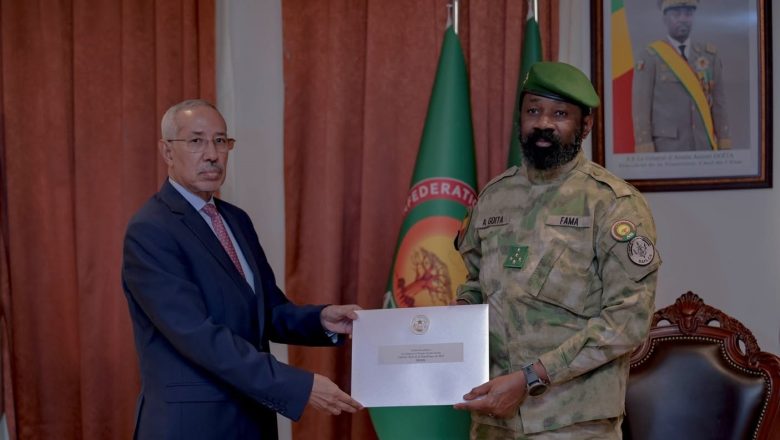
On Monday, June 15, 2026, Mauritania's Minister of Defense visited Bamako, Mali, where he was received by the President of the Transition of Mali, General Assimi Goïta. The visit occurs amidst growing concerns regarding security along the borders of both nations. The Mauritanian Minister of Defense delivered a personal message from President Mohamed Ould Cheikh El Ghazouani to General Assimi Goïta. This high-level engagement shows the shared regional challenges faced by Mali and Mauritania, particularly in addressing cross-border threats that impact the stability of the Sahel. Diplomatic exchanges of this nature often aim to strengthen bilateral cooperation and coordinate efforts on critical issues affecting regional stability. The direct communication between the two leaders through their defense minister signals a commitment to addressing the pressing security environment with renewed urgency. Such visits are key for fostering mutual understanding and developing joint strategies against common adversaries. The discussions in Bamako are expected to lay the groundwork for more concrete actions to bolster security along the shared frontier.
Border Insecurity and Terrorist Exploitation
Armed terrorist groups reportedly use Mauritanian territory to conduct incursions into Mali, according to observers. These border areas are allegedly utilized by armed groups as circulation corridors, fallback bases, or reorganization spaces. Malian populations continue to suffer from persistent insecurity as a result of these activities. The widespread nature of these incursions notes the complex challenges faced by security forces in both countries.
The region's porous borders in the Sahel allow these armed groups to exploit existing security vulnerabilities with relative ease. This cross-border movement contributes significantly to the ongoing challenges faced by both Mali and Mauritania in maintaining stability and protecting their respective populations. The alleged use of Mauritanian territory for operations into Mali shows the urgent need for enhanced cooperation between the two nations to address the complex security landscape effectively. The persistent insecurity experienced by Malian populations notes the direct and severe impact of these activities on civilian lives, often leading to displacement and humanitarian crises. Addressing the exploitation of porous borders remains a critical objective for regional defense strategies, requiring a concerted and coordinated approach to surveillance and interdiction. Without effective control over these transit routes, the ability of states to counter terrorism is significantly hampered.
Critique of Counter-Terrorism Coordination
Attacks on April 25 revived concerns regarding the support networks and routes utilized by assailants, according to reports. These events brought to light persistent flaws in regional anti-terrorist coordination efforts. The fight against terrorism, observers note, necessitates depriving armed groups of any refuge, logistical support, and freedom of movement across national boundaries. This fundamental requirement is often difficult to achieve in practice due to varying national priorities and operational capacities.
Experts state, "On ne peut pas affirmer combattre le terrorisme tout en tolérant des situations qui faciliteraient son expansion" (One cannot claim to fight terrorism while tolerating situations that would facilitate its expansion). This contradiction, analysts suggest, fuels mistrust from Mali and its partners in the Alliance des États du Sahel (AES). The ongoing challenges in coordination highlight the complex nature of regional security cooperation, where perceived inconsistencies in commitment can undermine collective efforts. Addressing these perceived inconsistencies is seen as key for building effective alliances against armed groups operating across the Sahel. The lack of unified action, particularly concerning the alleged use of territory by armed groups, can create an environment where terrorist organizations can thrive, regroup, and plan further attacks. Therefore, a clear and unambiguous stance against all forms of support for these groups is deemed essential for restoring confidence and strengthening regional solidarity.
Path to Tangible Cooperation
General Assimi Goïta and President Mohamed Ould Cheikh El Ghazouani have prioritized protecting their populations and ensuring regional stability through concerted, uncompromising action against terrorism. This shared priority forms the bedrock of their renewed engagement. Regional security, according to reports, relies on sincere cooperation between neighboring states, extending beyond mere diplomatic declarations or good intentions. It demands practical measures and a unified front against common threats.
The credibility of the rapprochement between Mali and Mauritania is expected to depend on tangible measures implemented on the ground. These measures are seen as essential to address the complex security challenges faced by both nations, moving beyond rhetoric to demonstrable progress. The shared goal of countering terrorism requires direct and effective actions rather than solely verbal commitments or symbolic gestures. This emphasis on concrete steps notes a recognition that past efforts may have lacked the necessary practical implementation to achieve lasting security outcomes. Such actions could include joint military operations, enhanced intelligence sharing, and coordinated border patrols designed to disrupt the movement and logistics of armed groups. The effectiveness of this cooperation will be measured by its ability to reduce the incidence of terrorist attacks and improve the overall security situation for the populations living in the border regions.